

Philadelphia is a city of historic homes. From the nineteenth-century rowhouses of West Philly and the craftsman bungalows of Mount Airy to the century-old twin homes of Northeast Philadelphia and the Victorian properties scattered throughout Germantown and Chestnut Hill, much of the city’s housing stock carries an architectural character that newer construction simply cannot replicate. But that same age brings a serious and often invisible risk: outdated electrical systems that were never designed to handle the demands of modern living.
The average Philadelphia home built before 1980 is operating on an electrical system that was designed for a fraction of the appliances, electronics, and power consumption that characterizes everyday life today. Smart TVs, home office setups, electric vehicle chargers, high-efficiency HVAC systems, modern kitchen appliances, and home automation devices collectively draw far more power than even a reasonably well-maintained older electrical system was built to deliver. The result is a system that is perpetually operating at or near its limits — and when electrical systems are pushed beyond their design capacity, the consequences range from nuisance-level inconveniences to genuine fire and safety hazards.
Electrical fires are one of the leading causes of house fires in Pennsylvania, and the vast majority of them are preventable with timely identification and repair of deteriorating electrical infrastructure. Knowing the warning signs that your home’s electrical system needs professional attention — and acting on them promptly — is one of the most important safety decisions a Philadelphia homeowner can make. Here are the seven most critical warning signs to watch for.

A circuit breaker that trips occasionally — particularly when you run a high-draw appliance like a hair dryer, vacuum cleaner, or space heater — is doing exactly what it was designed to do: protecting you from an overloaded circuit. An occasional trip is not, by itself, a reason for alarm. However, circuit breakers that trip repeatedly, multiple times per week, or that trip across several circuits simultaneously, are telling you something important: your electrical panel cannot safely handle the loads your household is placing on it.
Many older Philadelphia homes were built with 60-amp or 100-amp electrical service panels. Modern residential construction typically requires 150-amp to 200-amp service, and homes with electric vehicle chargers, central air conditioning, electric dryers, and multiple home office setups may require even more. If your home’s panel was sized for a 1950s lifestyle, it is almost certainly undersized for the demands of 2025 living — and the frequent tripping is your electrical system’s way of demanding attention before something more serious occurs.
Repeatedly resetting a tripping breaker without addressing the underlying cause is not a solution — it is a risk. If the breaker itself is worn out, it may eventually fail to trip when it should, eliminating the protection it provides. A licensed Philadelphia electrician can assess your panel’s capacity, identify overloaded circuits, and recommend the appropriate upgrade path.
Lights that flicker or dim when a large appliance starts up — like a refrigerator compressor, washing machine, or air conditioner — can indicate a capacity problem with your electrical panel, loose wiring connections, or an undersized circuit feeding those loads. While a brief, single dimming when a major appliance cycles on is relatively common in older homes, persistent flickering or dimming that occurs frequently or without an obvious trigger is a warning sign that deserves immediate attention.
Loose connections within the electrical panel, at junction boxes, or at individual outlets and switches are a particularly serious cause of flickering lights. Loose connections create resistance in the circuit, and resistance generates heat. Heat at an electrical connection is a direct precursor to electrical fires, which can ignite within wall cavities and burn undetected for extended periods before reaching visible surfaces. In Philadelphia’s older housing stock — where wiring may be aluminum rather than copper, or where original connections have loosened over decades of thermal expansion and contraction — loose connections are unfortunately common.
If your lights flicker consistently, unpredictably, or across multiple rooms simultaneously, do not ignore it. Schedule a professional electrical inspection to identify and correct the cause before it escalates into a more serious and costly problem.
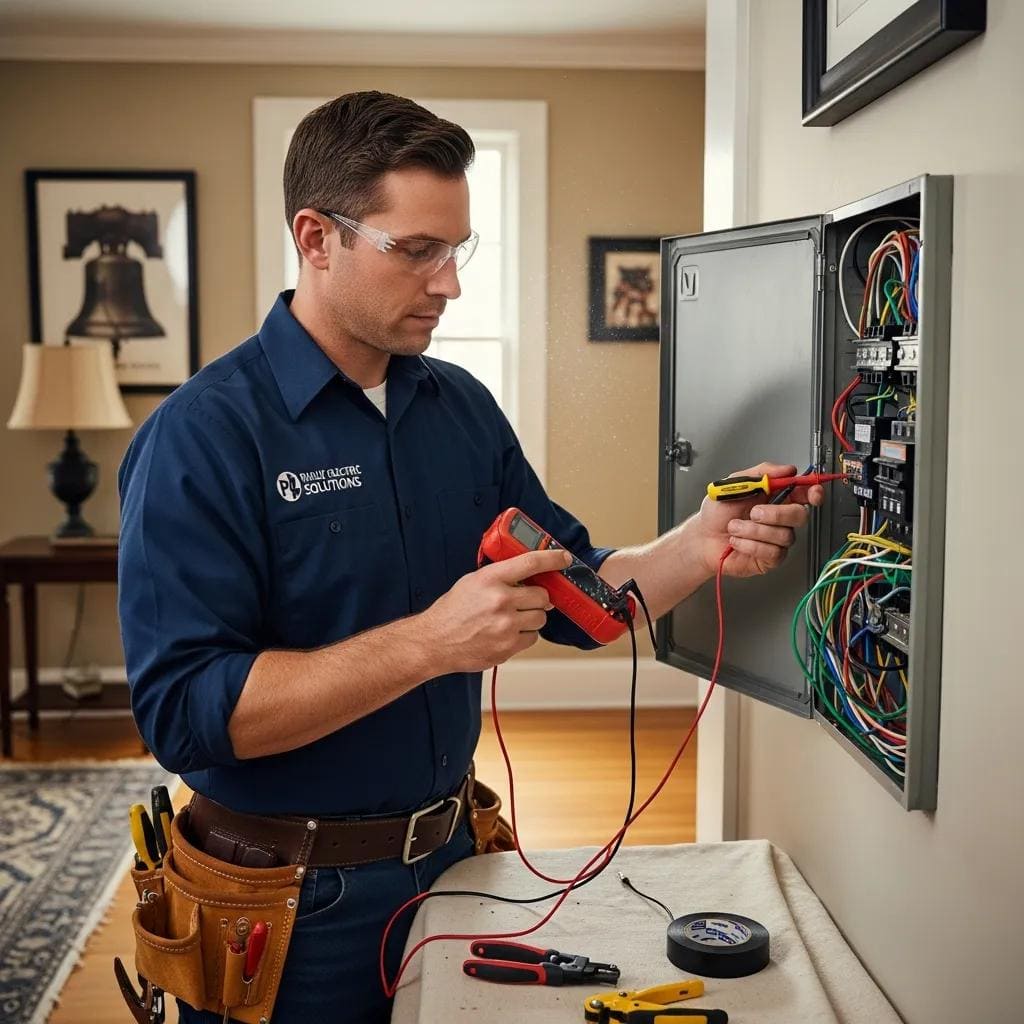

Electrical outlets should never be warm to the touch during normal use. Heat at an outlet indicates that the wiring behind it is carrying more current than it was designed for, that connections have loosened, or that the outlet itself is failing. Any outlet that feels warm — even slightly — when you touch the faceplate should be treated as a warning sign and inspected by a licensed electrician before continued use.
Discoloration around an outlet — brown or black scorch marks around the plug openings or on the faceplate — is an even more urgent warning. Scorching indicates that arcing has already occurred at that outlet. Arcing is an electrical discharge that jumps between conductors or between a conductor and ground, generating intense localized heat that can ignite surrounding materials instantly. A scorched outlet is evidence of a fire that was barely contained — and it may not be contained the next time.
A brief spark when you insert a plug into an outlet is normal — it is simply the result of the circuit completing as the plug makes contact. However, large sparks, sparks accompanied by a popping sound, or sparks at outlets that were recently in use (rather than being plugged in fresh) are not normal and indicate a serious wiring or connection problem.
If your Philadelphia home was built before 1960, there is a significant chance that many or all of its electrical outlets are ungrounded two-prong outlets rather than the three-prong grounded outlets required by modern electrical code. The third prong on a modern outlet is the ground — a critical safety feature that provides a safe discharge path for fault currents, protecting both the people using the outlet and the equipment plugged into it.
Ungrounded two-prong outlets do not just create inconvenience — they create real safety risks for sensitive modern electronics and for the occupants of the home. Computers, televisions, medical equipment, and home entertainment systems connected to ungrounded outlets are vulnerable to damage from electrical surges and faults that a grounded system would safely absorb. More critically, the absence of grounding eliminates a key layer of protection against electrocution and equipment fires.
Many homeowners attempt to solve this problem by using three-prong to two-prong adapter plugs — so-called ‘cheater plugs.’ This solution is dangerous: it provides the physical connection needed to plug in a three-prong device but completely eliminates the grounding protection that the third prong is designed to provide. The correct solution is upgrading the wiring to grounded three-prong outlets — a project that a licensed Philadelphia electrician can complete section by section, fitting within most homeowners’ budgets.
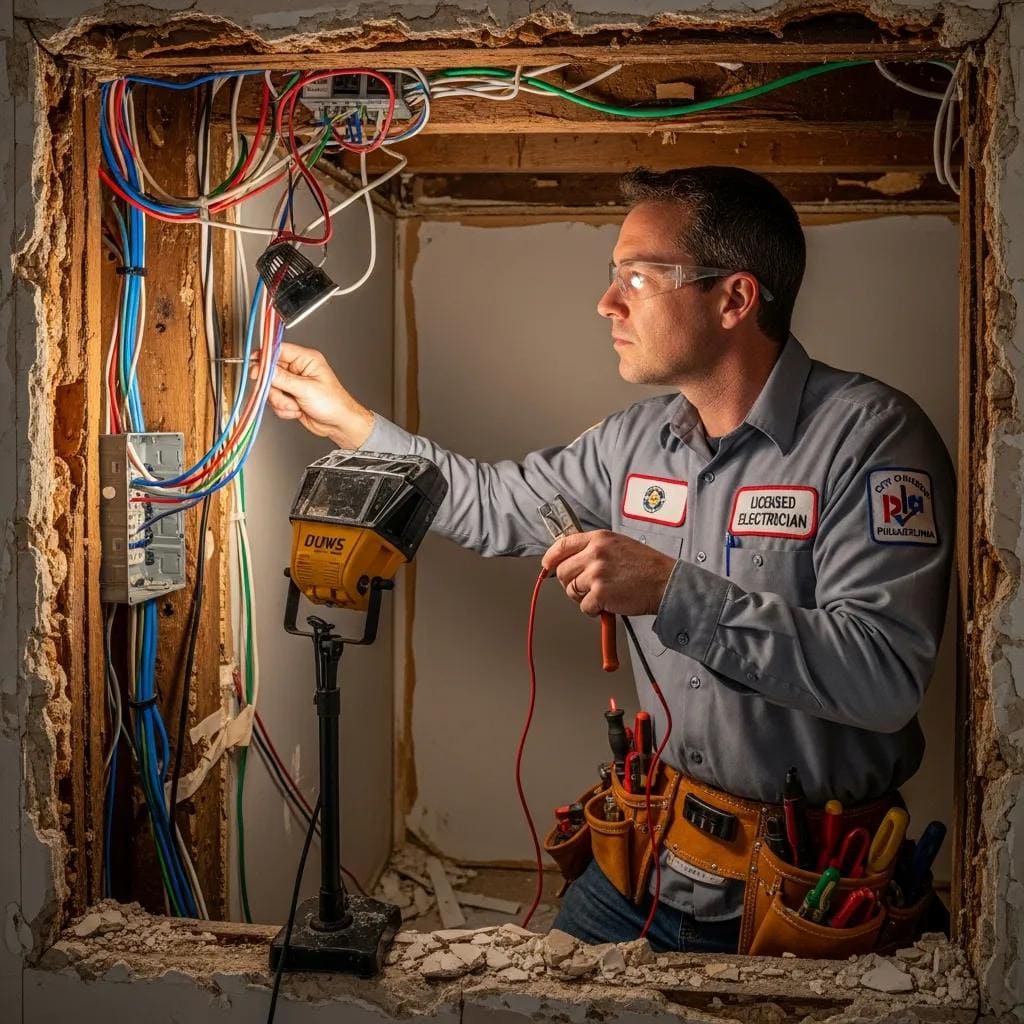
Two types of wiring are found in older Philadelphia homes that present elevated fire risks compared to modern copper wire: knob-and-tube wiring and aluminum wiring. Knob-and-tube wiring — installed in Philadelphia homes from approximately 1880 through the 1940s — consists of individual copper conductors run through ceramic knobs stapled to framing members and ceramic tubes where wires pass through joists and studs. It has no ground conductor and no protective sheathing, and its insulation — typically rubber or cloth — has often degraded significantly over the decades.
Aluminum wiring was widely used in residential construction during the 1960s and 1970s as a lower-cost alternative to copper. Aluminum wiring is not inherently dangerous in large-gauge applications like main service entries, but in the branch circuit wiring used for outlets, switches, and fixtures, aluminum expands and contracts at a different rate than the copper components it connects to. This differential movement causes connections to loosen over time, creating the resistance and heat buildup that leads to electrical fires. Homes with aluminum branch circuit wiring in Philadelphia have a documented higher risk of electrical fires and face challenges with homeowners’ insurance and property resale.
If your Philadelphia home was built before 1950, there is a strong possibility of knob-and-tube wiring in at least some areas. If it was built between 1965 and 1973, aluminum branch circuit wiring is likely. Both conditions require professional assessment and — depending on the condition — remediation, which may range from specific connection upgrades to full rewiring of affected areas.
Extension cords are designed for temporary, occasional use — not as permanent wiring solutions. When a home has too few outlets to meet the household’s actual power needs, and extension cords become a permanent fixture in certain rooms, this is both a safety hazard and a strong indicator that the home’s electrical system was not designed for modern living.
Permanently used extension cords — particularly those running under rugs, through doorways, or powering multiple devices through multi-outlet strips — are a leading cause of residential fires. Extension cords are not rated for continuous heavy loads, they can overheat, their insulation can be damaged by foot traffic and furniture, and multi-outlet strips connected to other multi-outlet strips (commonly called ‘daisy-chaining’) can easily overload circuits. In Philadelphia’s older rowhouses where bedroom outlets may number only one or two, the temptation to daisy-chain power strips is understandable — but the risk is real.
The correct solution is adding additional outlets on dedicated circuits where needed. A licensed electrician can assess your home’s needs, run new circuits from the panel to the appropriate locations, and install code-compliant outlets exactly where you need them — eliminating the need for extension cords and significantly improving both convenience and safety.
Even if your electrical panel is not displaying any of the obvious warning signs described above, age alone is a significant risk factor for residential electrical systems. Electrical panels have a typical service life of 25 to 40 years, after which internal components — circuit breakers, bus bars, connections, and insulation — have often degraded to the point where they can no longer be relied upon to perform safely under load.
Certain brands of electrical panels installed in Philadelphia homes during specific periods are known to have manufacturing defects that create elevated fire risks. Federal Pacific Electric Stab-Lok panels — widely installed in Philadelphia-area homes from the 1950s through the 1980s — have been the subject of extensive research showing that their circuit breakers fail to trip at alarmingly high rates under overload conditions. Zinsco panels from approximately the same era have similar documented reliability issues. If your home contains either of these panel brands, replacement is not optional — it is a genuine safety imperative.
A licensed Philadelphia electrician can inspect your existing panel, assess its condition and capacity, identify any known brand-specific concerns, and provide a clear recommendation for whether your panel requires immediate replacement, near-term upgrade, or simply continued monitoring.
If one or more of the warning signs described in this article apply to your Philadelphia home, the appropriate response is not to hope the problem resolves itself or to attempt a DIY fix. Electrical systems are unforgiving — mistakes or oversights can result in fires, equipment damage, and serious personal injury. The correct response is to schedule an inspection with a licensed Philadelphia electrician who can assess the full scope of your home’s electrical condition and provide a prioritized, cost-effective plan for bringing your system up to safe, code-compliant standards.
A professional electrical inspection for a typical Philadelphia rowhouse or single-family home typically costs between $150 and $350 — a minimal investment compared to the cost of fire damage, personal injury, or the emergency remediation cost of an electrical failure discovered during a real estate transaction. Many Philadelphia homeowners discover electrical issues during pre-sale inspections that derail transactions or require emergency repairs at the worst possible time. Proactive identification and remediation is always less expensive, less stressful, and safer than reactive emergency repair.
Post Tags :
Share :
Alb Electric is your trusted partner for safe, efficient, and affordable electrical solutions.